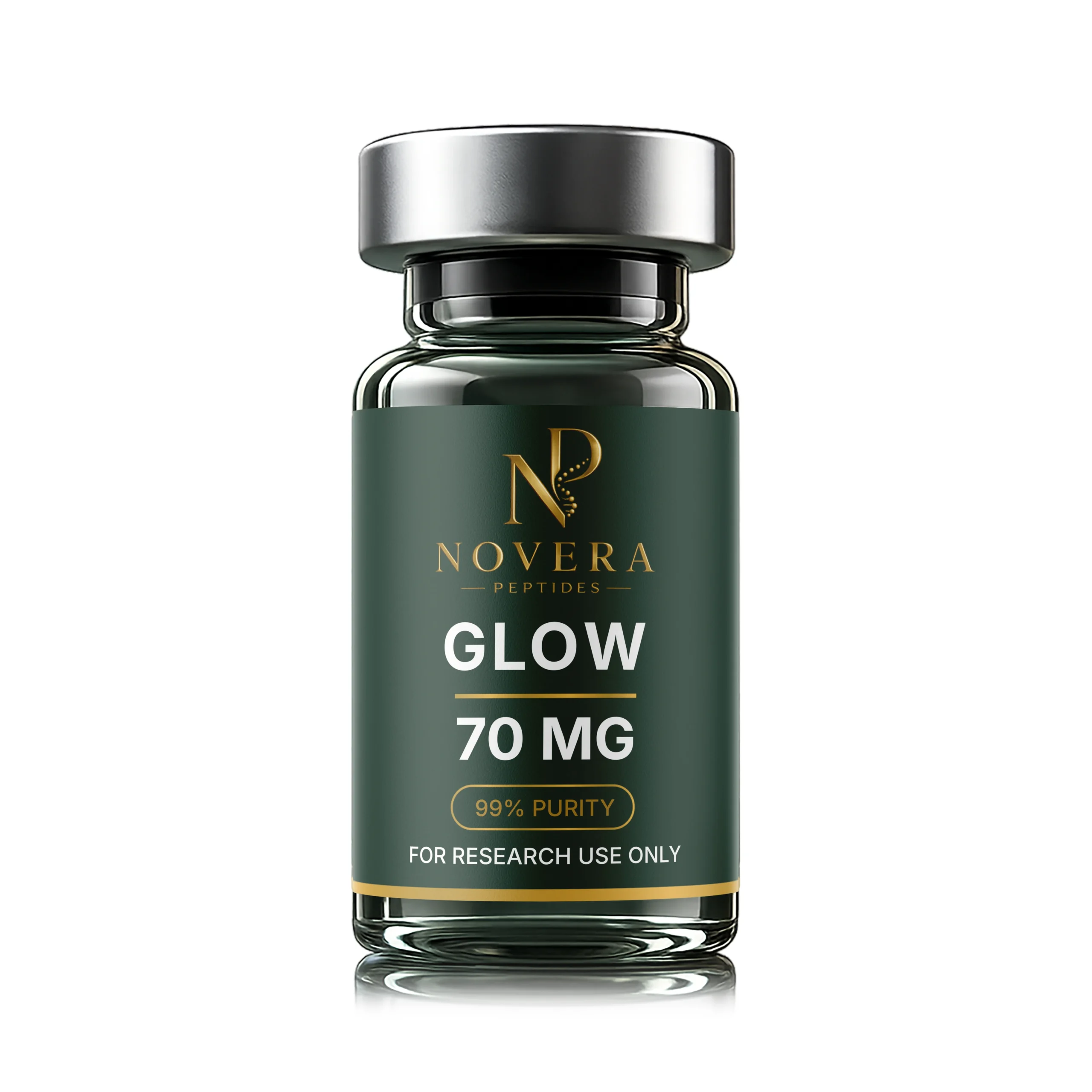

Glow Research Blend
GHK-Cu 50mg • BPC-157 10mg • TB-500 10mg
Glow Research Blend combines three extensively investigated research compounds that continue to attract scientific interest in regenerative biology, cellular communication, connective tissue physiology, and extracellular matrix research. Laboratory investigations explore how these compounds interact with biological pathways involved in tissue maintenance, molecular signaling, collagen biology, angiogenesis, and cellular adaptation under controlled experimental conditions.
Research Highlights
- Cellular communication and signaling research
- Connective tissue physiology
- Collagen and extracellular matrix biology
- Regenerative biology investigations
- Angiogenesis and vascular biology research
- Experimental tissue remodeling models
Introduction
Modern regenerative biology focuses on understanding how multiple biological signaling pathways work together to maintain normal tissue structure and cellular function. Glow Research Blend combines GHK-Cu, BPC-157, and TB-500, each of which has been independently investigated in laboratory research involving tissue physiology, molecular communication, and cellular maintenance.
Rather than evaluating a single signaling pathway, researchers continue to investigate how multiple biological systems interact during controlled laboratory studies involving connective tissue biology, extracellular matrix regulation, and regenerative processes.
Research Overview
Scientific literature has explored each component of Glow Research Blend across numerous experimental models. GHK-Cu has been investigated for copper-dependent biological activity and extracellular matrix regulation. BPC-157 has been widely studied in laboratory models involving connective tissue biology and cellular communication. TB-500 has received significant attention for its relationship with cellular migration, tissue physiology, and regenerative biology.
Together, these research compounds represent an area of growing scientific interest for investigators examining complex biological signaling networks rather than isolated cellular mechanisms.
Combined Research Applications
Researchers continue to investigate how multiple signaling pathways coordinate biological responses involved in tissue organization, collagen regulation, cellular migration, extracellular matrix remodeling, and physiological adaptation. Combination research allows investigators to evaluate how overlapping biological mechanisms contribute to normal tissue function within controlled laboratory environments.
These investigations continue to expand scientific understanding of regenerative biology and molecular communication across multiple experimental models.
Cellular Communication Research
Laboratory investigations continue to examine how cellular signaling pathways regulate communication between tissues, extracellular structures, and surrounding biological systems. Current research evaluates intracellular signaling, molecular regulation, and biological adaptation associated with regenerative processes.
Understanding these communication networks remains an important objective across multiple areas of modern biological research.
Connective Tissue and Extracellular Matrix Research
Current scientific literature continues to explore the relationship between extracellular matrix biology, connective tissue physiology, collagen organization, and tissue remodeling. Researchers investigate how these biological systems contribute to maintaining normal tissue architecture and structural integrity during laboratory investigations.
These pathways remain among the most extensively studied areas within regenerative biology research.
Regenerative Biology Research
Glow Research Blend has generated scientific interest because its components have each been investigated within experimental models involving tissue physiology, angiogenesis, molecular communication, cellular migration, and biological maintenance. Ongoing laboratory studies continue to evaluate these complex biological relationships across multiple research disciplines.
As regenerative science continues to evolve, combination research remains valuable for understanding how biological systems function together rather than independently.
Current Areas of Scientific Interest
- Cellular signaling pathways
- Regenerative biology
- Collagen biology
- Extracellular matrix regulation
- Connective tissue physiology
- Angiogenesis research
- Cell migration studies
- Molecular communication
- Tissue remodeling mechanisms
- Laboratory physiology models
Research Considerations
Current scientific findings should always be interpreted within the context of experimental methodology, study design, and laboratory limitations. While published research continues to expand scientific understanding of regenerative biology, additional investigation remains necessary to further characterize the complex biological interactions associated with combination research.
As with all investigational research materials, conclusions should be based upon peer-reviewed evidence generated under controlled laboratory conditions.
Laboratory Research Notice
This product is supplied exclusively for laboratory research, analytical testing, and scientific investigation. It is intended only for qualified research professionals operating within appropriate laboratory environments.
This product is not intended for human consumption, veterinary use, diagnosis, treatment, prevention, or cure of any disease.
For laboratory research use only. Not for human or animal consumption.
Sources & References
TYDES RESEARCH
GLOW Peptide Blend: GHK-Cu, TB-500, and BPC-157 in Regenerative Research
2025
Tydes Research
INTERNATIONAL JOURNAL OF MOLECULAR SCIENCES
Regenerative and Protective Actions of the GHK-Cu Peptide in the Light of the New Gene Data
2018
Pickart L, Margolina A
CURRENT PHARMACEUTICAL DESIGN
BPC 157 and Standard Angiogenic Growth Factors. Gastrointestinal Tract Healing, Lessons from Tendon, Ligament, Muscle and Bone Healing
2018
Seiwerth S, et al.
JOURNAL OF MOLECULAR MEDICINE
BPC-157 Interacts with the Nitric Oxide System
2016
Hsieh MJ, et al.
CELL AND TISSUE RESEARCH
Gastric Pentadecapeptide Body Protection Compound BPC 157 and Its Role in Accelerating Musculoskeletal Soft Tissue Healing
2019
Gwyer D, et al.
MOLECULES
Pentadecapeptide BPC 157 Enhances the Growth Hormone Receptor Expression in Tendon Fibroblasts
2014
Chang CH, Tsai WC, Hsu YH, Pang JH
JOURNAL OF INVESTIGATIVE DERMATOLOGY
Thymosin Beta-4 Accelerates Wound Healing
1999
Malinda KM, et al.

Reviews
There are no reviews yet.