

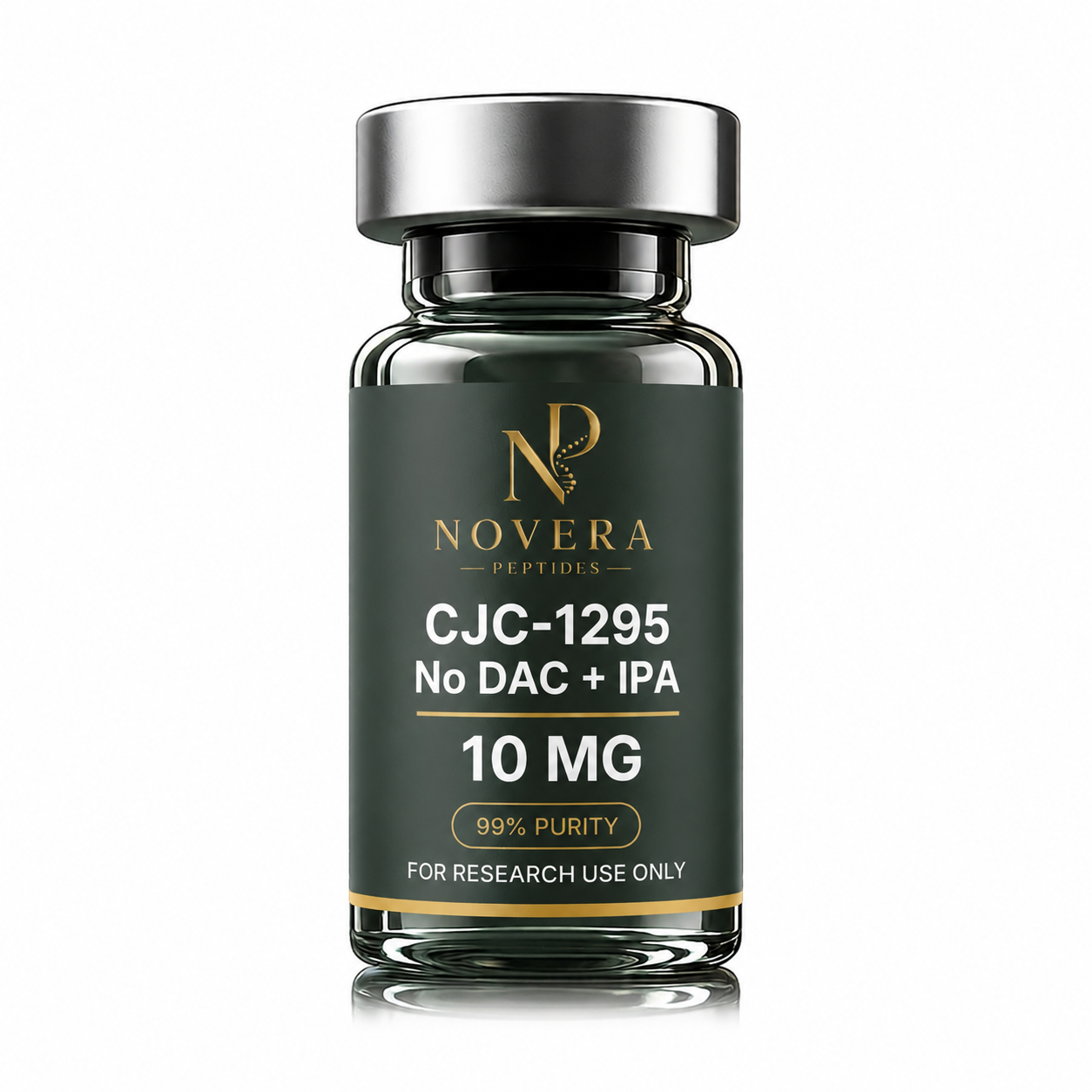

CJC-1295 No DAC + IPA
Research Highlights
- Growth hormone signaling research
- GHRH receptor biology
- Ghrelin receptor pathway investigation
- GH/IGF-1 axis regulation
- Endocrine communication studies
- Metabolic physiology research
CJC-1295 No DAC and Ipamorelin are investigational research compounds studied for their relationship with growth hormone signaling, endocrine communication, and the GH/IGF-1 axis. Researchers have examined each compound individually and in combination because of their distinct mechanisms of action and relevance in laboratory models involving hormone regulation and cellular communication.
This combination remains an area of scientific interest for investigators studying growth hormone release patterns, receptor activity, metabolic physiology, and broader endocrine signaling pathways within controlled research environments.
Introduction
Growth hormone signaling is one of the most studied areas of endocrine research because of its connection to metabolism, tissue physiology, protein regulation, and cellular adaptation. CJC-1295 No DAC and Ipamorelin have gained attention in laboratory research because they interact with separate but related biological pathways involved in growth hormone activity.
CJC-1295 No DAC is commonly studied for its relationship with growth hormone-releasing hormone activity, while Ipamorelin has been evaluated for its interaction with ghrelin receptor signaling. Together, these pathways provide researchers with a model for studying how multiple endocrine signals may influence hormone-related biological responses.
Growth Hormone Signaling Research
Researchers continue to study the biological systems that regulate growth hormone release, receptor communication, and downstream signaling. These investigations often focus on how endocrine pathways interact with cellular metabolism, tissue biology, and the IGF-1 signaling network.
CJC-1295 No DAC and Ipamorelin are frequently evaluated in this area because they allow scientists to examine separate signaling mechanisms that may contribute to growth hormone-related research models.
CJC-1295 No DAC Research
CJC-1295 No DAC is a synthetic analog of growth hormone-releasing hormone investigated for its role in endocrine signaling and growth hormone release patterns. Laboratory studies have evaluated its pharmacokinetic profile, receptor activity, and interaction with hormone-regulating systems under controlled experimental conditions.
Unlike longer-acting DAC-modified versions, the No DAC form is often studied for shorter-duration signaling characteristics, making it useful in research involving pulse-like growth hormone activity and endocrine feedback mechanisms.
Ipamorelin Research
Ipamorelin is a selective growth hormone secretagogue studied for its relationship with ghrelin receptor pathways and hormone-response signaling. Research has focused on its receptor selectivity, biological response mechanisms, and endocrine activity in both preclinical and clinical research settings.
Its selective signaling profile has made Ipamorelin a frequent subject of investigation in studies exploring growth hormone release, receptor biology, and communication between metabolic and endocrine systems.
GH/IGF-1 Axis Research
The GH/IGF-1 axis plays an important role in laboratory research involving endocrine physiology, tissue regulation, metabolic signaling, and cellular adaptation. Scientific investigations involving CJC-1295 No DAC and Ipamorelin often examine how growth hormone activity may influence IGF-1-related pathways and downstream biological responses.
Researchers continue to explore how these signaling networks function together within controlled experimental environments, contributing to a broader understanding of hormone regulation and molecular communication.
Endocrine and Metabolic Research
Beyond growth hormone signaling, CJC-1295 No DAC and Ipamorelin have been studied in relation to metabolic physiology, energy regulation, protein metabolism, and adaptive biological response systems. These areas remain important for researchers examining how endocrine signals interact with broader physiological networks.
Current research continues to evaluate how hormone-related pathways may influence cellular communication, nutrient signaling, and metabolic regulation within laboratory models.
Current Areas of Scientific Interest
- Growth hormone signaling pathways
- GHRH receptor biology
- Ghrelin receptor research
- GH/IGF-1 axis regulation
- Endocrine communication systems
- Hormone release pattern research
- Metabolic physiology
- Protein metabolism
- Cellular adaptation mechanisms
- Laboratory endocrinology models
Research Considerations
Scientific findings involving CJC-1295 No DAC and Ipamorelin should always be interpreted within the context of study design, methodology, sample size, and experimental limitations. Ongoing research continues to expand scientific understanding of growth hormone signaling, receptor activity, and endocrine physiology.
As with all investigational research materials, conclusions should be based on peer-reviewed evidence, controlled laboratory conditions, and appropriate scientific interpretation.
Laboratory Research Notice
This product is supplied exclusively for laboratory research, analytical testing, and scientific investigation. It is intended only for qualified research professionals operating within appropriate laboratory environments.
This product is not intended for human consumption, veterinary use, diagnosis, treatment, prevention, or cure of any disease.
For laboratory research use only. Not for human or animal consumption.
Sources & References
Prolonged stimulation of growth hormone (GH) and insulin-like growth factor I secretion by CJC-1295
2006
Sam L Teichman, et al.
Therapeutic peptides in gerontology: mechanisms and applications for healthy aging
2026
Volodymyr Mavrych, et al.
Pulsatile Secretion of Growth Hormone (GH) Persists during Continuous Stimulation by CJC-1295.
2006
Madalina Ionescu, et al.
Injectable Peptide Therapy: A Primer for Orthopaedic and Sports Medicine Physicians
2026
Cory K Mayfield, et al.
Activation of the GH/IGF-1 axis by CJC-1295, a long-acting GHRH analog, results in serum protein profile changes in normal adult subjects
2009
Lucila Sackmann-Sala, et al.
Ipamorelin, the first selective growth hormone secretagogue
1998
K Raun, et al.
Pharmacokinetic-Pharmacodynamic Modeling of Ipamorelin, a Growth Hormone Releasing Peptide, in Human Volunteers
1999
J.V.S. Gobburu, et al.
Methylprednisolone Does Not Inhibit the Release of Growth Hormone After Intravenous Injection of a Novel Growth Hormone Secretagogue (Ipamorelin) in Rats
2000
K. Malmlöf, et al.

Reviews
There are no reviews yet.