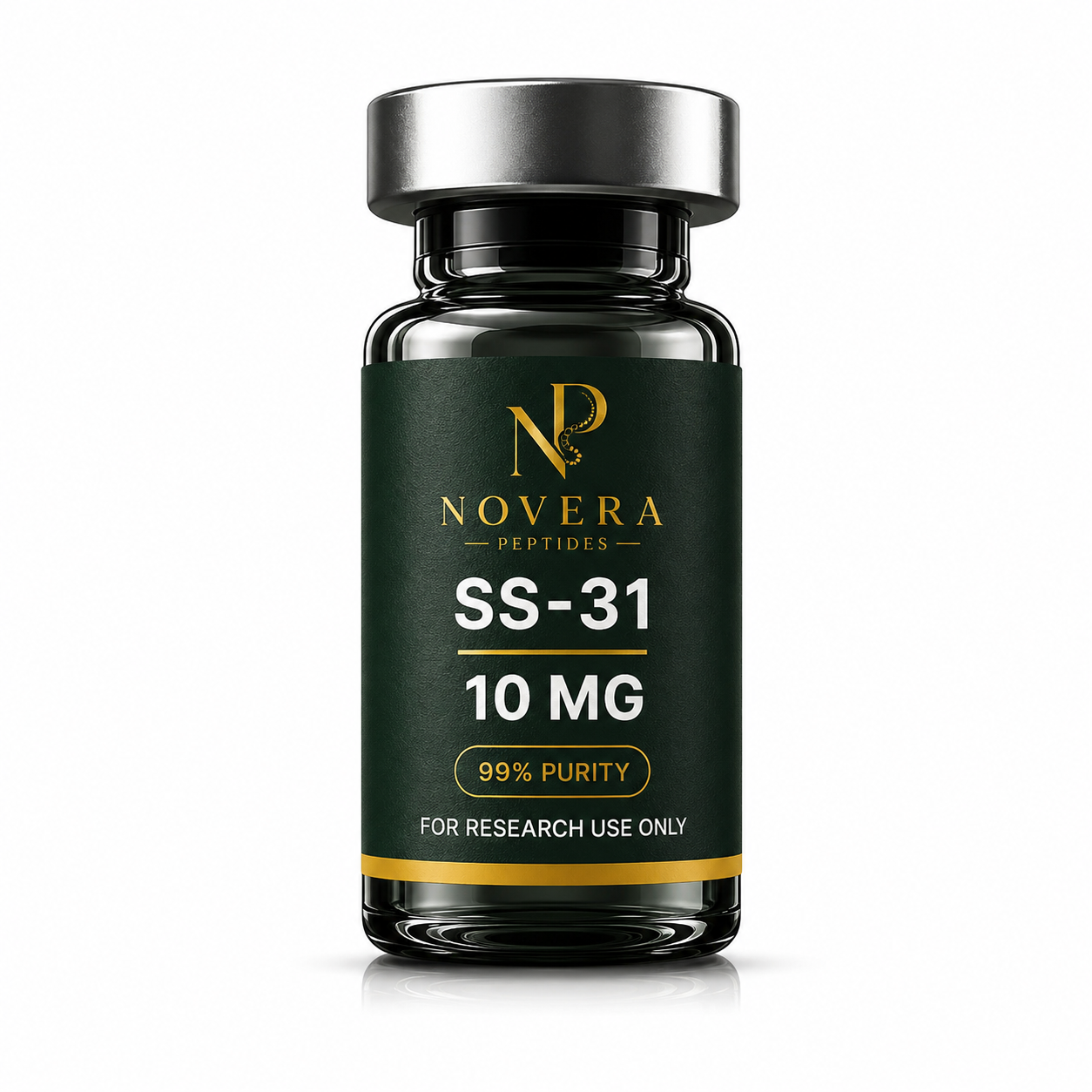

SS-31

Categories:

SS-31 is an investigational laboratory compound extensively studied for its role in mitochondrial function, cellular bioenergetics, and oxidative stress research. Scientific investigations continue to explore its interaction with mitochondrial membranes, energy production pathways, and cellular resilience under controlled laboratory conditions.For laboratory research use only.

$55.00

Out of stock

Out of stock

vERFIED
PURITY

Secure
Payment

Third-party
Tested

Research Use Disclaimer

Research Use Only: All products offered are intended strictly for laboratory research purposes. Products are not for human consumption and are not intended for diagnostic, therapeutic, or medical use. By purchasing from our website, customers confirm they are qualified researchers or laboratories and understand the intended research-use designation.

SS-31 10 mg

Research Highlights

  • Mitochondrial function research
  • Cellular bioenergetics investigation
  • Oxidative stress biology studies
  • Cardiac tissue research
  • Skeletal muscle physiology research
  • Age-related cellular function studies

SS-31 is an investigational laboratory compound that has become an important focus of mitochondrial biology research. Scientific investigations continue to examine its interaction with mitochondrial membranes and cellular energy production under controlled laboratory conditions.

Current published research explores SS-31 in experimental models involving mitochondrial function, oxidative stress, cellular metabolism, muscle physiology, and cardiovascular biology, making it one of the most extensively investigated mitochondrial-targeting research compounds.

Introduction

Mitochondria are responsible for producing the majority of cellular energy. Researchers continue to investigate how mitochondrial efficiency influences tissue physiology, cellular adaptation, and biological aging. SS-31 has emerged as a valuable laboratory material for studying these mechanisms.

Laboratory investigations examine how mitochondrial-targeted compounds may influence cellular bioenergetics, membrane stability, and oxidative stress pathways within controlled research environments.

Mitochondrial Research

Scientific studies have evaluated SS-31 for its interaction with mitochondrial membranes involved in cellular energy production. Researchers continue to investigate mitochondrial efficiency across multiple laboratory models.

These investigations contribute to a broader understanding of cellular respiration, ATP production, and mitochondrial communication within experimental systems.

Cellular Bioenergetics Research

Current research explores how mitochondrial function supports normal cellular activity. Experimental studies continue to evaluate cellular energy metabolism and adaptive responses under laboratory conditions.

Researchers are investigating mechanisms associated with energy utilization, oxidative metabolism, and cellular resilience using controlled experimental models.

Oxidative Stress Research

Published laboratory investigations continue to examine oxidative stress pathways and their relationship with mitochondrial physiology. Researchers study how reactive oxygen species influence cellular function and biological adaptation.

These investigations expand scientific understanding of mitochondrial homeostasis and cellular redox biology.

Current Areas of Scientific Interest

  • Mitochondrial membrane biology
  • Cellular bioenergetics
  • ATP production research
  • Oxidative stress physiology
  • Cardiovascular laboratory models
  • Skeletal muscle physiology
  • Neurological research models
  • Healthy aging investigations
  • Metabolic biology
  • Cellular adaptation mechanisms

Research Considerations

Scientific findings involving SS-31 should always be interpreted within the context of controlled laboratory investigations. While published research continues to expand understanding of mitochondrial biology, additional investigation remains necessary to further characterize its biological activity across multiple research models.

As with all investigational laboratory materials, conclusions should be based on peer-reviewed evidence generated under controlled scientific conditions.

Laboratory Research Notice

This product is supplied exclusively for laboratory research, analytical testing, and scientific investigation. It is intended only for qualified research professionals operating within appropriate laboratory environments.

This product is not intended for human consumption, veterinary use, diagnosis, treatment, prevention, or cure of any disease.

For laboratory research use only. Not for human or animal consumption.

Lorem ipsum dolor sit amet, consectetur adipiscing elit. Ut elit tellus, luctus nec ullamcorper mattis, pulvinar dapibus leo.

Lab Report
Date Added :
07/10/2026

SS-31 10 mg

Research Highlights

  • Mitochondrial function research
  • Cellular bioenergetics investigation
  • Oxidative stress biology studies
  • Cardiac tissue research
  • Skeletal muscle physiology research
  • Age-related cellular function studies

SS-31 is an investigational laboratory compound that has become an important focus of mitochondrial biology research. Scientific investigations continue to examine its interaction with mitochondrial membranes and cellular energy production under controlled laboratory conditions.

Current published research explores SS-31 in experimental models involving mitochondrial function, oxidative stress, cellular metabolism, muscle physiology, and cardiovascular biology, making it one of the most extensively investigated mitochondrial-targeting research compounds.

Introduction

Mitochondria are responsible for producing the majority of cellular energy. Researchers continue to investigate how mitochondrial efficiency influences tissue physiology, cellular adaptation, and biological aging. SS-31 has emerged as a valuable laboratory material for studying these mechanisms.

Laboratory investigations examine how mitochondrial-targeted compounds may influence cellular bioenergetics, membrane stability, and oxidative stress pathways within controlled research environments.

Mitochondrial Research

Scientific studies have evaluated SS-31 for its interaction with mitochondrial membranes involved in cellular energy production. Researchers continue to investigate mitochondrial efficiency across multiple laboratory models.

These investigations contribute to a broader understanding of cellular respiration, ATP production, and mitochondrial communication within experimental systems.

Cellular Bioenergetics Research

Current research explores how mitochondrial function supports normal cellular activity. Experimental studies continue to evaluate cellular energy metabolism and adaptive responses under laboratory conditions.

Researchers are investigating mechanisms associated with energy utilization, oxidative metabolism, and cellular resilience using controlled experimental models.

Oxidative Stress Research

Published laboratory investigations continue to examine oxidative stress pathways and their relationship with mitochondrial physiology. Researchers study how reactive oxygen species influence cellular function and biological adaptation.

These investigations expand scientific understanding of mitochondrial homeostasis and cellular redox biology.

Current Areas of Scientific Interest

  • Mitochondrial membrane biology
  • Cellular bioenergetics
  • ATP production research
  • Oxidative stress physiology
  • Cardiovascular laboratory models
  • Skeletal muscle physiology
  • Neurological research models
  • Healthy aging investigations
  • Metabolic biology
  • Cellular adaptation mechanisms

Research Considerations

Scientific findings involving SS-31 should always be interpreted within the context of controlled laboratory investigations. While published research continues to expand understanding of mitochondrial biology, additional investigation remains necessary to further characterize its biological activity across multiple research models.

As with all investigational laboratory materials, conclusions should be based on peer-reviewed evidence generated under controlled scientific conditions.

Laboratory Research Notice

This product is supplied exclusively for laboratory research, analytical testing, and scientific investigation. It is intended only for qualified research professionals operating within appropriate laboratory environments.

This product is not intended for human consumption, veterinary use, diagnosis, treatment, prevention, or cure of any disease.

For laboratory research use only. Not for human or animal consumption.

Sources & References

INTERNATIONAL JOURNAL OF MOLECULAR SCIENCES

Elamipretide: A Review of Its Structure, Mechanism of Action, and Therapeutic Potential

2025
Tung C, et al.

View Source ↗

NEUROLOGY

Efficacy and Safety of Elamipretide in Individuals With Primary Mitochondrial Myopathy: The MMPOWER-3 Randomized Clinical Trial

2023
Karaa A, et al.

View Source ↗

JOURNAL OF THE AMERICAN SOCIETY OF NEPHROLOGY

The Mitochondrial-Targeted Peptide SS-31 Re-Energizes Ischemic Kidneys by Interacting With Cardiolipin

2013
Birk AV, et al.

View Source ↗

BRITISH JOURNAL OF PHARMACOLOGY

First-in-Class Cardiolipin-Protective Compound as a Therapeutic Agent to Restore Mitochondrial Bioenergetics

2014
Szeto HH.

View Source ↗

CELL REPORTS

Mitochondrial Protein Interaction Landscape of SS-31

2020
Chavez JD, et al.

View Source ↗

NEUROLOGY

Randomized Dose-Escalation Trial of Elamipretide in Adults With Primary Mitochondrial Myopathy

2018
Karaa A, et al.

View Source ↗

PHARMACOLOGY RESEARCH

Contemporary Insights Into Elamipretide’s Mitochondrial Mechanism of Action and Therapeutic Effects

2025
Szeto HH, et al.

View Source ↗

FRONTIERS IN PHYSIOLOGY

Cardiolipin Remodelling in Mitochondrial Therapeutics: Translational Evidence Chains From Elamipretide to Emerging Strategies

2026
Di K, et al.
View Source ↗

Reviews

There are no reviews yet.

Be the first to review “SS-31”

Your email address will not be published. Required fields are marked *

Age Verification!

*By continuing, you confirm eligibility and legal compliance.